For contractors and general contractors managing crews across multiple active job sites, labor tracking is one of the most operationally complex challenges in the business. Each site has different foremen, different trade mixes, different cost codes, and different phases of work happening simultaneously. Without a system that captures this complexity accurately, project managers are working from lagging indicators — weekly summary reports that tell them what happened, not what’s happening.
Dedicated construction workforce time tracking software gives project managers a real-time view of where labor hours are going across every active site. Hours by cost code, by crew, by trade, by phase — updated daily, not weekly — so decisions can be made while there’s still time to affect outcomes.
The Multi-Site Management Challenge
Contractors running three or more simultaneous projects face a specific visibility problem. A crew that’s productive on one site may be underutilized on another. Overtime on Project A may be offsetting under-utilization on Project B. Without consolidated labor data across sites, these imbalances are invisible until payroll runs — which is too late to act on them.
Site-level tagging in time tracking software solves this. Every time entry is associated with a specific site, so reports can be sliced by site, by cost code across sites, or by crew across sites — whatever the project manager needs to answer the question in front of them.
Connecting Labor to Budget in Real Time
The budget vs. actual comparison is the core metric of construction project management. When actual hours by cost code are visible daily, project managers can see which scopes are on track and which are running over — while there’s still time to adjust crew allocation, revise the remaining scope plan, or have a budget conversation with the owner. The same data that arrives at month-end as a problem arrives daily as an opportunity.
For construction firms that also employ developers building internal tools or managing technology infrastructure, developer time tracking in the same system means all labor — field and office — is visible in one consolidated report.
Payroll Integration and Compliance
Construction payroll is complex: prevailing wage rates on public projects, overtime thresholds that vary by jurisdiction, certified payroll requirements for federally funded work. Time tracking software that integrates with payroll systems — or at minimum exports in a format payroll can consume directly — reduces the manual work involved in translating time records into accurate paychecks and compliance documentation.
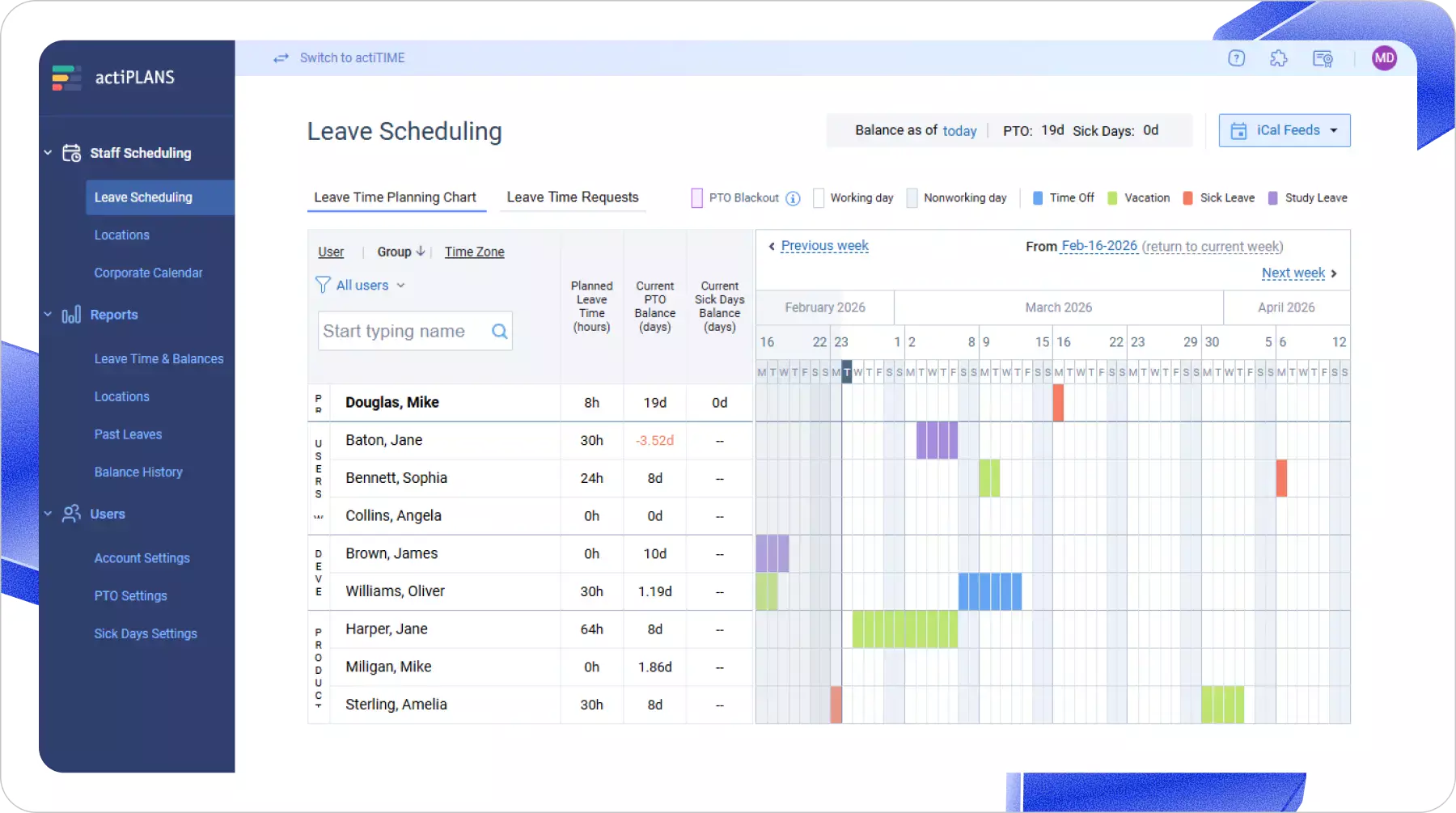
Managing which staff are available on which days — accounting for leave, PTO, and project rotations — is equally important. actiPLANS handles the absence management side so project schedulers always know actual crew availability before making site assignments.
Implementation That Works in the Field
Field adoption is the make-or-break factor for any construction time tracking implementation. Software that works on a tablet or smartphone with minimal steps gets used. Software that requires a laptop and multiple menu levels does not. Prioritize mobile-first interfaces, offline capability for sites with poor connectivity, and foreman-level bulk entry — where one person can log time for an entire crew in a single session. Get that right and the data quality follows automatically.